Metro Detroit renter guide
Restroom Trailer vs Porta Potty: Which Is Right for Your Wedding?
The right wedding restroom depends on guest count, power and water, the ground and your budget. Here is a side-by-side comparison.
By Roman, owner. Reviewed October 13, 2026
Is a restroom trailer or porta potty better for a wedding?
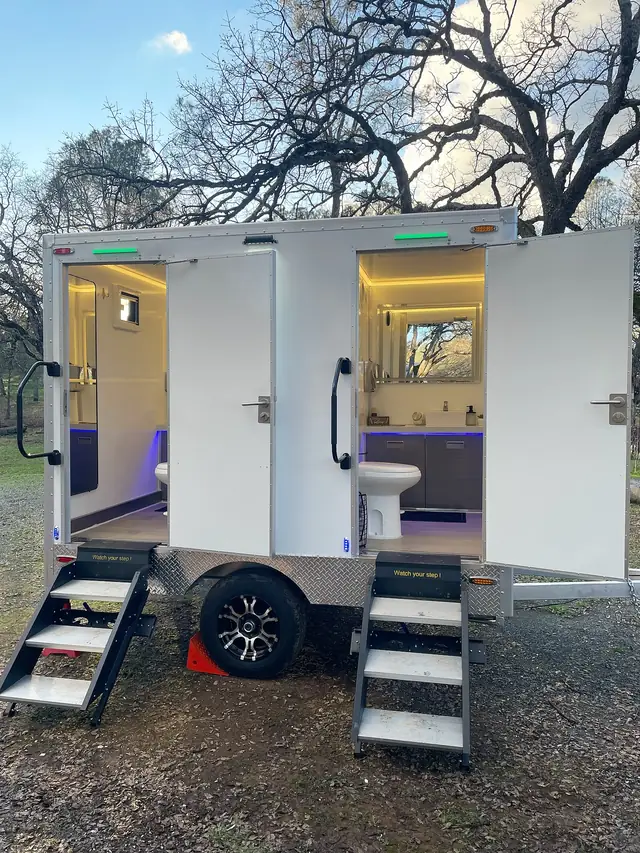
A restroom trailer is better for weddings over 100 guests, formal evening receptions and winter dates, because it has flushing toilets, running water, lights and climate control. Porta potties, especially flushing units with sinks, are better when the site has no power or water, the budget is tight, or the guest list is under 100.
| Flushing porta potties | Restroom trailer | |
|---|---|---|
| Feel | Clean, private, foot-pump flush and sink | Like an indoor bathroom |
| Power / water | None needed | Outlet within 100 ft; hose or tank |
| Ground | 4 ft × 4 ft level spot each | Level 10 ft × 20 ft, truck path |
| Lights / heat | Daylight roof; lights add-on | Built-in lights and climate control |
| Starting price | $275 per unit | $895 (2-stall) |
How many restrooms does a wedding need?
Using our sizing method, a 6-hour wedding with a bar works out like this: a 100-guest wedding needs 4 portable units or a 2-stall trailer, and a 150-guest wedding needs 6 units or a 3- to 4-stall trailer. Include at least 1 wheelchair-accessible unit when you use portable units.
Run your exact numbers in the porta potty calculator.
Need units now? Call (313) 476-6006 by noon, Monday through Saturday, for same-day delivery in Detroit and nearby suburbs.
What does the site need for a restroom trailer?
A restroom trailer needs a level spot about 10 by 20 feet, a standard 110-volt outlet within about 100 feet, a garden hose or a filled tank, and a path at least 10 feet wide and 13 feet high for the truck. Barns without power can use a generator.
Can you mix trailers and porta potties?
Yes. Many couples rent a 2-stall trailer near the reception tent and 1 or 2 standard units near the parking area or for the catering crew. Mixing keeps lines short and the budget in check.